
Best Vehicle to Start an NEMT Business (and What It Costs)
By Coach Willena McGee, RN-BSN · AAA-Accredited NEMT Training Provider
For most non-emergency medical transportation (NEMT) startups, the right first vehicle is an ADA-compliant wheelchair-accessible van — typically a converted minivan or full-size van — and you should budget roughly $65,000 for a properly converted vehicle. It's usually the single largest purchase in your launch budget. But the most important thing about the NEMT vehicle isn't the make or model — it's the timing. The vehicle comes last, after your model, your positioning, and your funding are in place.
I lost my first medical transportation company to bankruptcy, and one lesson from that season shapes everything I teach now: the van is not the business. The business is the model, the relationships, and the funding — the van is just the equipment that serves them. So let's talk about the equipment: what to buy, what it costs, and when to buy it.
The main vehicle types for NEMT
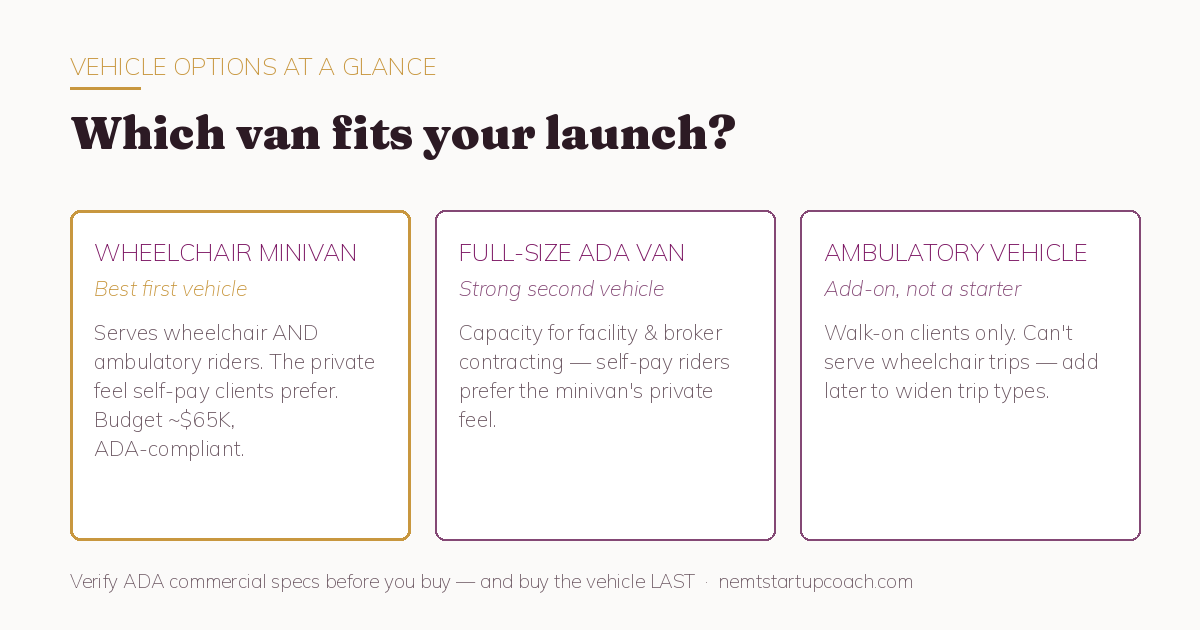
Wheelchair-accessible minivan conversion. The workhorse of premium self-pay NEMT. A minivan converted with a lowered floor and a rear-entry or side-entry ramp. Easy to drive, easy to park at facilities and homes, comfortable for the rider, and professional in appearance. For most founders, this is the right first vehicle.
Full-size ADA van. More capacity and more room for larger wheelchairs or additional passengers, at a higher purchase price and operating cost. A strong second vehicle once trip volume and contracts justify it — and it shines in facility contracting and Medicaid/broker work, where capacity is the point. Premium self-pay clients, though, tend to prefer the more private, personal feel of the minivan — one more reason the minivan leads in the self-pay model.
Ambulatory vehicle (sedan or standard minivan). For clients who can walk and transfer on their own, no conversion is required. Some owners add an ambulatory vehicle later to serve more trip types at lower cost — but if you start with only one vehicle, start with the wheelchair-accessible van, because it can serve both ambulatory and wheelchair clients. An ambulatory-only vehicle cannot do the reverse.
Rear-entry vs. side-entry conversions: don't shop by price or entry style — shop by ADA compliance. A more affordable conversion is not necessarily an ADA-compliant one: compliance comes down to the specifics of the build — door width and height, interior dimensions, the lowered floor, ramp specifications, and securement systems. And in most cases, side-entry conversions are designed with private family use in mind, not commercial service. For a business, the typical choice is a fully ADA-compliant commercial conversion — most often rear-entry. Whatever you buy, verify the conversion meets ADA commercial specifications before you sign.
What the vehicle really costs
In my launch model, the ADA-converted vehicle is budgeted at about $65,000 — the largest single line in the roughly $120,000 it takes to launch properly. That's a realistic figure for a quality converted vehicle rather than the cheapest thing that rolls.
New vs. used: a newer vehicle costs more but brings warranty coverage, reliability, and the professional appearance that premium self-pay clients and facilities expect. An older, cheaper vehicle can look like savings and then eat the difference in repairs and downtime — and in this business, downtime means missed medical appointments and lost trust. If you go used, have the conversion equipment (ramp, tie-downs, lowered floor) inspected as carefully as the engine.
Remember what the vehicle is to a lender: a recoverable asset. That's why vehicle financing is the easier part of NEMT funding — and why the real funding challenge is the working capital that keeps you operating while trips ramp up. I cover that whole picture in How to Get Funding for a NEMT Business.
What your vehicle says about your company
In premium self-pay NEMT, the vehicle is part of your positioning. Before a facility refers a patient or a family books a ride for their mother, they're judging what they can see: Is it clean? Is it newer? Is the equipment maintained? Does the company look like a healthcare service or a side hustle?
That's why I teach founders to think of the vehicle as a rolling first impression — climate-controlled, spotless, properly equipped with secure tie-downs, and branded professionally. The premium model charges premium rates, and the vehicle has to look like the rates.
When to buy the vehicle (this is the part that matters)
Last. After the model is designed, the brand is positioned, the funding is secured. This is the order I walk through in How to Start a NEMT Business Step by Step — BUILD, POSITION, PREPARE, and only then PROFIT, which is where the vehicle purchase lives.
Buy the van first and you've committed your capital before you know your pricing, your clients, or your funding. Buy it last and it arrives with trips already waiting for it. Same van — completely different business.
One more piece of good news: for standard NEMT vehicles like these, you usually don't need a CDL — a regular driver's license typically covers it, though rules vary by state.
FAQ
What is the best vehicle for a NEMT business? For most startups, a wheelchair-accessible minivan conversion — professional, easy to operate, and able to serve both wheelchair and ambulatory clients. Budget roughly $65,000 for a quality converted vehicle.
How much does a NEMT wheelchair van cost? Plan on roughly $65,000 for a properly ADA-converted vehicle. Prices vary with new vs. used, conversion type, and equipment.
Can I start a NEMT business with a regular minivan? For ambulatory-only clients, yes — but a wheelchair-accessible van serves both ambulatory and wheelchair riders, which is why it's the smarter first vehicle for a premium model.
Do I need a CDL to drive a NEMT van? Usually not — standard NEMT vehicles typically fall below CDL thresholds. Verify your state's rules.
Should I buy the vehicle before starting my NEMT business? No — the vehicle comes last. Design the model, position the brand, and secure funding first, so the van arrives with a business already built around it.
Want the full build order before you spend a dollar on a van? My free Healthcare Transportation Startup Brief walks you through the premium self-pay model and the right sequence — before you buy the vehicle. Get the free brief here.
Coach Willena McGee, RN-BSN, is an AAA-accredited NEMT training provider (TP24831) who lost her first medical transportation company to bankruptcy and now coaches healthcare professionals to launch premium, self-pay NEMT companies the right way.
This article is general education, not legal or financial advice. Vehicle, licensing, and insurance requirements vary by state — verify locally.
About the author Coach Willena McGee, RN BSN, is the founder of WM NEMT Startup Coach® and an AAA-accredited NEMT training provider. She coaches nurses, caregivers and career changers through building a non-emergency medical transportation company the right way, drawing on her nursing background and her lived operator experience. Work with me


