
Do You Need a CDL for NEMT? Usually Not. Here's When You Do
By Coach Willena McGee, RN-BSN · AAA-Accredited NEMT Training Provider
In most cases, no — you do not need a CDL (commercial driver's license) to start or drive for a non-emergency medical transportation (NEMT) business. Standard NEMT vehicles like minivans and ADA-converted vans typically fall below the thresholds that trigger CDL requirements. A CDL generally only comes into play with larger vehicles — commonly those designed to carry 16 or more passengers including the driver, or very heavy vehicles. Requirements vary by state, so always verify your local rules before you launch.
This is one of the first questions I hear from healthcare professionals thinking about starting a NEMT company — and the answer surprises most people. The license is rarely the barrier. Let's walk through what actually determines whether you need a CDL, and what you do need instead.
When a CDL is usually NOT required
The typical premium NEMT fleet is built on minivans and ADA-converted vans that seat a handful of passengers. Vehicles in this class generally sit well below CDL thresholds. That means for the standard self-pay NEMT model I teach — serving private clients, seniors, and facility referrals with wheelchair-accessible vans — a regular driver's license is usually all that's legally required to drive the vehicle.
That's good news for two reasons: it lowers the barrier for you as the owner, and it widens your hiring pool when you're ready to bring on drivers.
When a CDL (or extra licensing) MAY be required
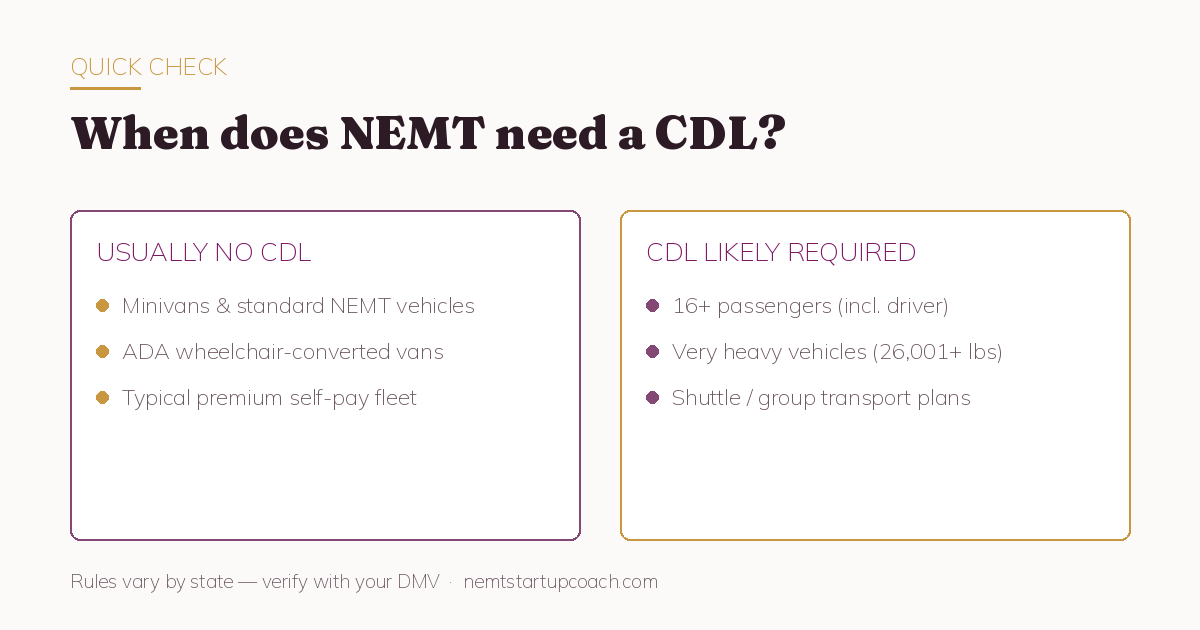
CDL rules are generally triggered by vehicle size and passenger capacity, not by the type of business. The common triggers:
Passenger capacity: vehicles designed to carry 16 or more people including the driver typically require a CDL with a passenger endorsement.
Vehicle weight: very heavy vehicles (commonly 26,001+ lbs) trigger CDL requirements.
State-specific rules: some states add their own licensing layers, endorsements, or chauffeur/for-hire permits for smaller passenger vehicles. This is where you must verify locally — your state DMV and your local licensing office are the source of truth.
If your growth plan someday includes a shuttle-style vehicle or group transport, that's when CDL questions become real. For most premium self-pay NEMT startups, they're not the starting line.
What you DO need instead of a CDL
Skipping the CDL doesn't mean skipping standards. In healthcare transportation, trust is the product — and the operators who win facility referrals are the ones who can show their standards. Plan for:
A clean driving record — for you and every driver you hire. Insurers and facilities both care.
Background checks and drug screening — expected in anything healthcare-adjacent.
Driver training — defensive driving, wheelchair securement, and passenger assistance training. CPR/first aid certification strengthens your credibility with facilities.
Commercial auto insurance — your personal policy will not cover commercial passenger transport.
Business licensing and local permits — your business registration and any state or local for-hire transportation permits your area requires.
These, not a CDL, are the real requirements that make a NEMT business insurable, referable, and fundable.
The bigger point: the license was never the hard part
Here's what I want you to take from this: the question that stops most people — "do I need a special license?" — usually has an easy answer. The parts that actually determine whether your company survives are the ones nobody asks about first: the model you choose, the pricing that makes trips profitable, and the funding — roughly $120,000, mostly financed — that gets you launched with working capital, not just a van. That's the order I teach in How to Start a NEMT Business Step by Step, and the money side is covered in How Much Does It Really Cost to Start a NEMT Business?
FAQ
Do NEMT drivers need a CDL? Usually not. Standard NEMT vehicles like minivans and wheelchair-accessible vans typically fall below CDL thresholds. Larger vehicles — commonly 16+ passengers including the driver — generally do require one. Verify your state's rules.
What license do you need to start a NEMT business? Typically a regular driver's license for the vehicle, plus your business registration, any state or local for-hire transportation permits, and commercial auto insurance. Requirements vary by state.
Do NEMT drivers need special training? Formal training requirements vary by state, but facilities and insurers expect trained drivers — defensive driving, wheelchair securement, passenger assistance, and often CPR/first aid.
Can I drive for my own NEMT company? Yes — most founders start as an owner-operator driving their first vehicle, then hire drivers as trip volume grows.
Does an ADA wheelchair van require a CDL? Typically no. Standard ADA-converted vans seat well under the passenger threshold that triggers CDL requirements. Confirm with your state DMV.
Do you need a CDL to drive a step van or small bus for NEMT? It depends on the vehicle, not the job title. Under federal rules, a CDL is generally required when a vehicle's weight rating is 26,001 pounds or more, or it's designed to carry 16 or more people including the driver. Most step vans and cutaway buses used in NEMT fall below those lines, but check the vehicle's rating and your state's rules before you buy.
Wondering what the real requirements are? My free Healthcare Transportation Startup Brief walks you through the premium self-pay model and the right build order — before you buy the vehicle. Get the free brief here.
Coach Willena McGee, RN-BSN, is an AAA-accredited NEMT training provider (TP24831) who lost her first medical transportation company to bankruptcy and now coaches healthcare professionals to launch premium, self-pay NEMT companies the right way.
This article is general education, not legal advice. Licensing and driver requirements vary by state and vehicle — verify with your state DMV and local licensing office.
About the author Coach Willena McGee, RN BSN, is the founder of WM NEMT Startup Coach® and an AAA-accredited NEMT training provider. She coaches nurses, caregivers and career changers through building a non-emergency medical transportation company the right way, drawing on her nursing background and her lived operator experience. Work with me


