
Do You Need a Business Plan for a NEMT Business? (2026)
By Coach Willena McGee, RN-BSN · AAA-Accredited NEMT Training Provider
Yes — if you plan to borrow money to launch a non-emergency medical transportation (NEMT) business, you need a real business plan, and lenders can tell the difference between a real one and a filled-in template. A lender-facing plan isn’t a writing exercise. It’s the written record of business decisions you’ve already made: who you serve, what you charge, how a ride gets booked and paid, how the company operates, and what the money is for. Build those decisions first, and the plan becomes something you can explain and defend across the desk.
Here’s the moment I see over and over. A nurse or caregiver has filed her LLC, gotten her EIN, maybe even collected a quote on a van. Then someone says, “You’ll need a business plan for the loan,” and she does what feels responsible: she searches for a template.
That instinct is understandable. It’s also the most common place a NEMT launch quietly goes sideways.
Why a template feels like progress — and isn’t
A template gives you blanks to fill. The trouble is that most of the blanks are decisions you haven’t made yet. Who exactly is your paying buyer? What lane are you in? How are trips priced, and what’s included? What happens when a client cancels? Where does the money go first?
When those answers don’t exist yet, the template gets filled with polished language instead. It reads well. But polished words can’t fix shaky logic — and lenders read a lot of plans. The first follow-up question exposes it.
Filing your LLC wasn’t wrong. It was one step. Now it’s time to build the business that filing is supposed to support — before the larger bills begin.
What lenders are actually looking for
I’m not a lender and this isn’t lending advice, but the pattern is consistent: whether you’re talking to an SBA lender, a bank, or a CDFI, a startup plan is being read for clarity and coherence. Lenders want to see that:
You know who pays you. Not “everyone who needs a ride” — a specific buyer, in a specific service area, with a reason to choose you.
Your pricing has logic behind it. Rates built from your real costs, not copied from a competitor or a broker’s rate sheet. (I covered the principles in How to Price NEMT Services.)
Your operations are thought through. How rides are booked, scheduled, paid for, and what your service boundaries are.
The money has a job. What you’re asking for, what it funds, and why — including the working capital that carries you while trips ramp up, not just the vehicle. (How to Get Funding for a NEMT Business goes deeper.)
You can explain it. If you can’t answer a question about your own plan without flipping pages, it isn’t really yours yet.
The order that actually works
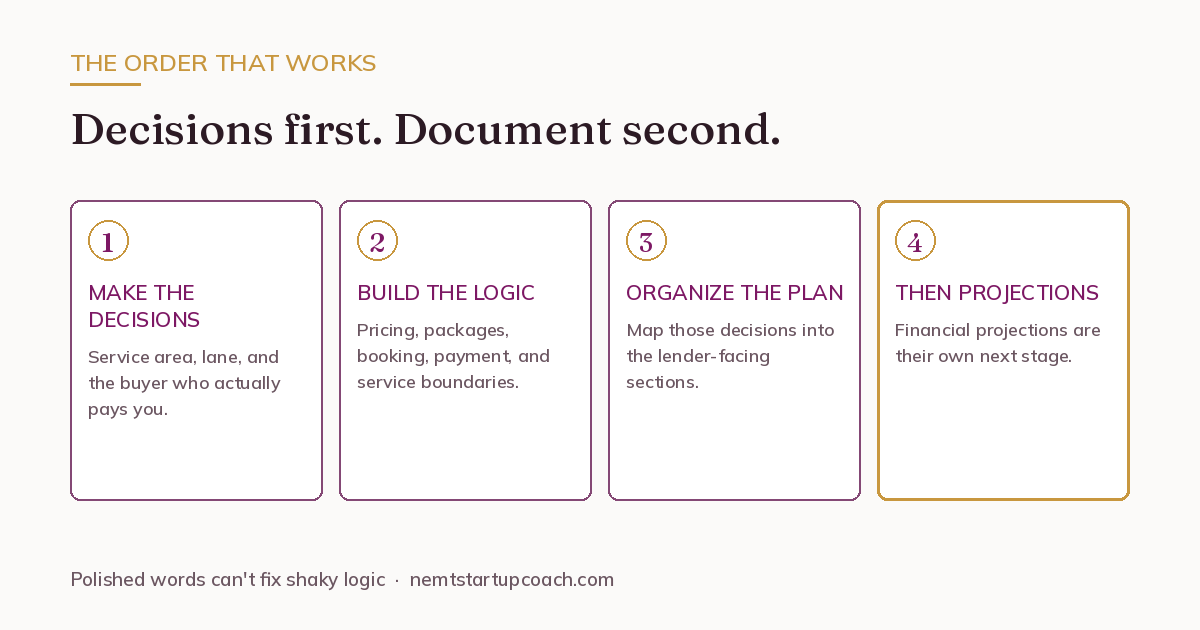
The fix is a sequence, not a better template: make the decisions first, then organize them into a lender-facing plan. Decide your service area and lane. Define your paying buyer. Build your pricing logic and packages. Set your booking, payment, and service boundaries. Then map those decisions into the plan’s sections — and you’ll know exactly which parts are complete and which still need research.
One honest boundary: a strong strategic foundation is not the same as finished financial projections. Projections are their own next stage, and a plan isn’t ready for lender submission until they’re done. Anyone who tells you a template produces a “lender-ready plan” in an afternoon is selling you the shortcut that costs the most.
Signs your plan isn’t ready yet
You started by searching for a template.
Sections are filled with language you couldn’t explain out loud.
Your pricing came from what someone else charges.
“Who is your customer?” makes you pause.
The only operating detail you’re sure of is the vehicle.
If two or more of those hit home, that’s not failure — that’s information. It means the business behind the plan still needs building.
FAQ
Do you need a business plan to start a NEMT business? If you’re borrowing to launch, yes — lenders expect one. Even if you self-fund, building the decisions behind a plan protects your savings from expensive guesses.
Can I use a NEMT business plan template? A template can organize decisions you’ve already made. It can’t make them for you. Filling one with guesses produces a plan that reads well and falls apart under questions.
What do lenders look for in a NEMT business plan? Clarity and coherence: a defined paying buyer, pricing with real logic, thought-through operations, a clear use of funds including working capital, and an owner who can explain all of it.
Does a business plan guarantee NEMT funding? No. A strong plan improves how clearly your company is understood; approval depends on the lender, your credit, your capital, and more.
Is a business plan the same as financial projections? No. Projections are a separate stage built on top of your business decisions. A plan isn’t ready for submission until both are done.
Build the business behind your business plan — before the bills start. That’s exactly what my Build Before You Borrow™ — The NEMT Business Plan Masterclass walks you through: make the decisions first, then organize them into a lender-facing plan foundation you understand and can defend. See Build Before You Borrow here.
Coach Willena McGee, RN-BSN, is an AAA-accredited NEMT training provider (TP24831) who lost her first non-emergency medical transportation company to bankruptcy and now coaches healthcare professionals to launch premium, self-pay NEMT companies the right way.
About the author Coach Willena McGee, RN BSN, is the founder of WM NEMT Startup Coach® and an AAA-accredited NEMT training provider. She coaches nurses, caregivers and career changers through building a non-emergency medical transportation company the right way, drawing on her nursing background and her lived operator experience. Work with me


