How to Price NEMT Services: Self-Pay Rates Done Right (2026)
By Coach Willena McGee, RN-BSN · AAA-Accredited NEMT Training Provider
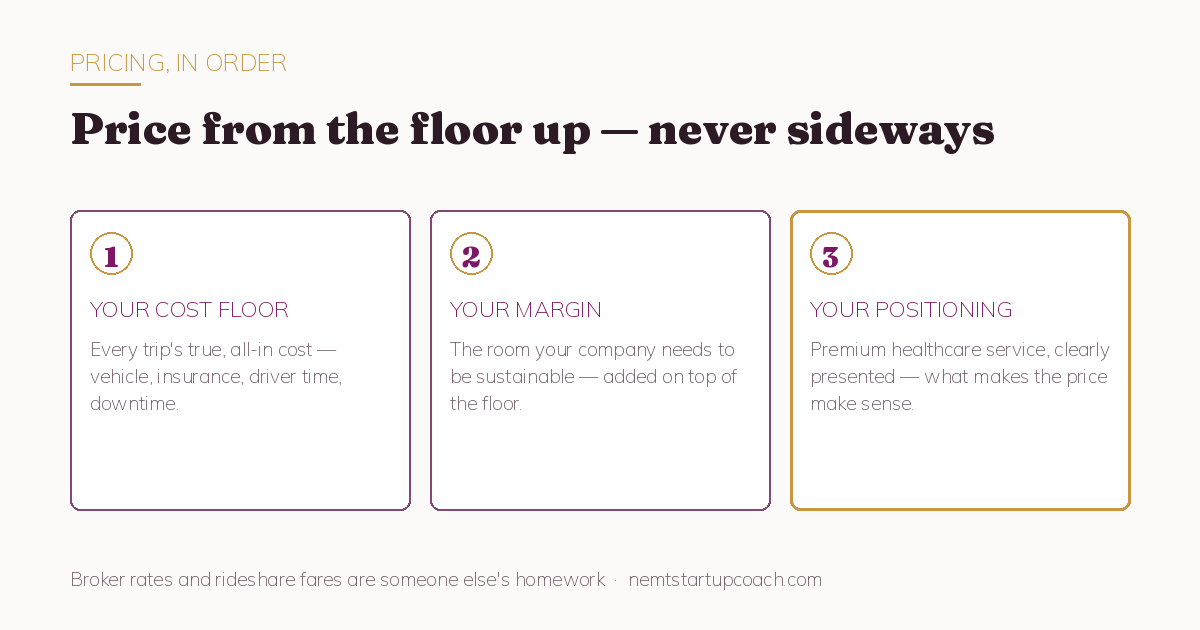
Pricing non-emergency medical transportation (NEMT) services correctly comes down to three principles: know your true cost per trip (your floor), price from that floor up with a real margin (never sideways from broker rates or rideshare fares), and position the service so the price makes sense — premium healthcare transportation priced like the healthcare service it is. The most common pricing mistake in NEMT isn't charging too much. It's underpricing so quietly that the company loses money on trips it celebrates winning.
I won't hand you a rate sheet in this post — and you should be suspicious of anyone who does, because a stranger's rates weren't built on your costs, your market, or your model. What I'll give you is the way profitable owners think about pricing, so you stop guessing.
Principle 1: Your true cost per trip is the floor
Before any price makes sense, you have to know what a trip actually costs you — all of it: the vehicle's share, commercial insurance, fuel, maintenance, the driver's full time including the empty miles, dispatch and admin, and downtime. Owners who skip this math end up "profitably busy" — full calendars, empty accounts. It's the same silent killer I named in Why NEMT Businesses Fail, wearing a pricing costume.
Your floor isn't your price. It's the line under your price. If a rate doesn't clear the floor with room to spare, it's not revenue — it's a subsidy you're paying to look busy.
Principle 2: Price from the floor up — never sideways
Here's how most new owners actually set prices: they look sideways. At broker rates. At rideshare fares. At the competitor's website. And every one of those numbers was built for someone else's model — broker rates for the broker's margin, rideshare fares for an app with no wheelchair lift, the competitor's price possibly for a company quietly going broke.
Premium self-pay pricing works the other way: cost floor → margin → price. You start from what the trip truly costs, add the margin your company needs to be sustainable, and check that against what your positioning supports. That's the order. Anything else is copying someone else's homework without knowing if they passed. The full model comparison lives in Self-Pay vs. Medicaid NEMT.
Principle 3: Positioning is what makes the price make sense
A premium price on a rideshare-looking service confuses people. The same price on ahealthcare transportationservice — trained driver, door-through-door assistance, ADA equipment, on-time reliability a facility can stake its reputation on — reads as fair. Families paying for a parent's dialysis transport aren't shopping for the cheapest ride; they're paying for dignity and dependability. Facilities refer to companies they trust, not the ones that undercut everyone.
Your price and your positioning must tell the same story. When they do, "expensive" stops coming up — because you're no longer being compared to the wrong category.
The three pricing mistakes to avoid
Rideshare benchmarking. You are not competing with an app. Different service, different equipment, different responsibility — different price.
The discount spiral. Winning trips by cutting price attracts price-shoppers, who leave the moment someone cuts lower. Premium clients areloyalclients.
Set-and-forget. Costs move — insurance, fuel, wages. A price that was healthy at launch can be underwater a year later. Profitable owners re-run the floor math on a schedule.
Where the actual numbers get built
Principles tell youhow to think. Your actual rates — your cost floor worked out line by line, your margin targets, your projections, the plan a lender can read — that's the working session, and it's exactly what my Build Before You Borrow business planning masterclass walks you through. This post is the compass; the masterclass is the map withyournumbers on it.
FAQ
How much should I charge for NEMT services? There's no universal rate — correct pricing starts from your true cost per trip (your floor), adds a sustainable margin, and is supported by premium healthcare positioning. Copying broker rates or rideshare fares is the fastest way to underprice.
Why are self-pay NEMT rates higher than broker rates? Because they're pricing a different product: door-through-door healthcare transportation with trained drivers and ADA equipment, priced from real costs — not a volume rate built for a broker's margin.
Should NEMT prices be listed on my website? That's a positioning decision. Many premium companies quote after understanding the client's needs, because trips differ — distance, assistance level, schedule. What matters is that every quote clears your cost floor.
How often should NEMT prices be reviewed? On a schedule — at minimum annually, and any time a major cost moves (insurance renewal, fuel trends, driver wages). Your floor moves; your prices must know it.
What if clients say my price is too high? Price objections usually mean positioning hasn't done its job — the client is comparing you to the wrong category. Premium service, clearly presented, changes the comparison from "cheapest ride" to "safest hands."
Ready to build your actual numbers? Build Before You Borrow— my business planning masterclass — is where the cost floor, the projections, and the bank-ready plan get built with your figures. Join Build Before You Borrow here
Not ready yet? Start with my free Healthcare Transportation Startup Brief: Get the free brief here.
Coach Willena McGee, RN-BSN, is an AAA-accredited NEMT training provider (TP24831) who lost her first non-emergency medical transportation company to bankruptcy and now coaches healthcare professionals to launch premium, self-pay NEMT companies the right way.
About the author Coach Willena McGee, RN BSN, is the founder of WM NEMT Startup Coach® and an AAA-accredited NEMT training provider. She coaches nurses, caregivers and career changers through building a non-emergency medical transportation company the right way, drawing on her nursing background and her lived operator experience. Work with me


