
How to Get Facility Contracts for a NEMT Business (2026)
By Coach Willena McGee, RN-BSN · AAA-Accredited NEMT Training Provider
Facility contracts are one optional growth path for a NEMT company. My core framework starts with premium, self-pay clients without depending on Medicaid, brokers, or facility contracts. Founders who later choose to pursue agreements with assisted living communities, rehabilitation providers, infusion practices, or discharge teams can evaluate whether that path fits their model, capacity, and pricing. This article explains that optional path; it is not a requirement to launch.
When people hear "NEMT contracts," most think of broker contracts — signing up to receive assigned Medicaid trips at the broker's rates. That's one path, and I compared the two models honestly in Self-Pay vs. Medicaid NEMT. A self-pay company may choose facility agreements as an additional channel: direct agreements with facilities that choose you — and pay your rates. Here's how those relationships actually get built.
Facility relationships as an optional growth path
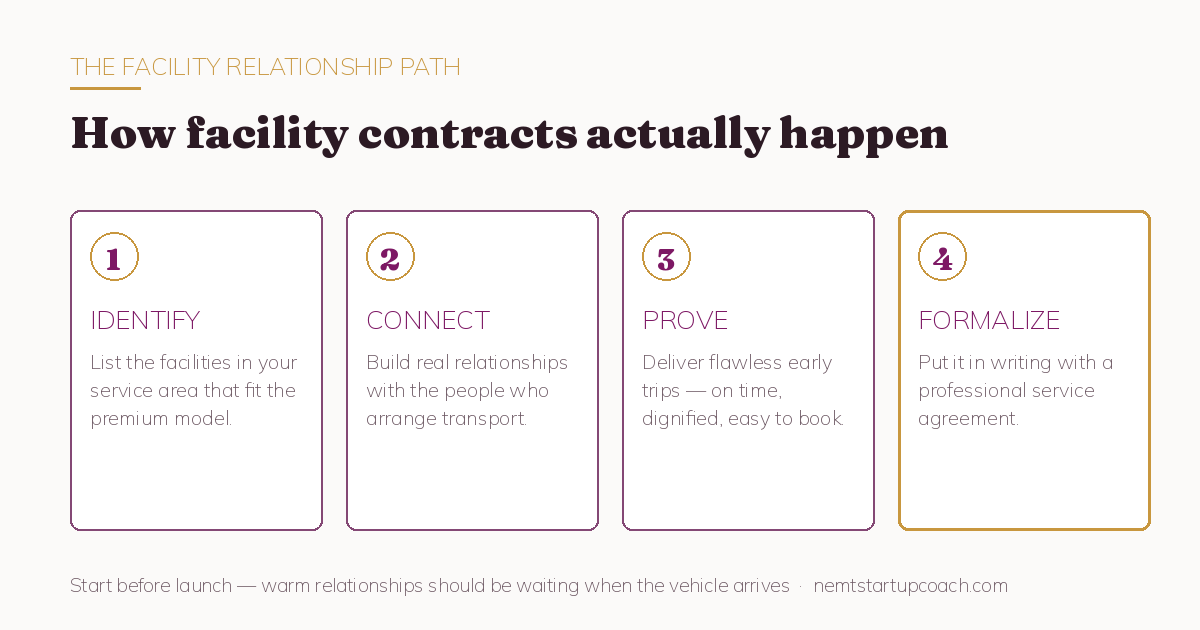
An optional path for founders who choose facility agreements: identify, connect, demonstrate, and formalize.
Some assisted living communities, rehabilitation facilities, infusion practices, and discharge teams arrange transportation for clients whose needs fit a premium self-pay service. If you choose this path, learn how each organization handles transportation and where your company may add value.
A dependable, dignified transportation partner solves a real operational headache — which is why the facilities in your area are not a cold audience. They're an underserved one. The question they're silently asking is the one your whole company should answer: can we trust this operator with our residents?
Step 1: Identify the right facilities
If facility agreements fit your model, identify assisted living and senior communities, outpatient rehabilitation and infusion providers, adult day programs, and hospital discharge teams in your service area. Evaluate each potential relationship against your capacity, pricing, and the clients you want to serve.
Prioritize relationships that fit your self-pay model and service scope, including senior communities and families arranging transportation for loved ones.
Step 2: Build the relationship before you need it
Contracts don't start with paperwork. They start with a person — the administrator, activities director, social worker, or discharge planner who feels the transportation problem every week.
Introduce yourself professionally. Learn how they currently handle transportation and where it breaks down. Be visible in the local healthcare community. This is genuine relationship-building, not a pitch — and it's exactly why I tell founders to begin this in the POSITION stage of the build order, before launch. When your vehicle hits the road, the relationships should already be warm.
Step 3: Prove the standard
Premium facilities refer premium partners. What earns the trust:
Show up like a healthcare company: professional branding, a real website, trained drivers, a clean ADA-compliant vehicle.
Deliver flawlessly on the first trips. Use the first trips to demonstrate punctual service, assistance within your service scope, and clear communication when plans change.
Make their job easier: simple booking, clear pricing, and consistent follow-up. Make transportation arrangements easy to understand and coordinate.
This is where your credentials work for you. As a nurse, I never had to convince a facility that I understood patient dignity and safety — and if you're a healthcare professional, neither will you.
Step 4: Formalize it with a service agreement
When the relationship is real and the trust is earned, put it in writing. A professional service agreement protects both sides: services, rates, scheduling, cancellation terms, and responsibilities — so the relationship runs on clarity instead of memory.
This is a place to invest in doing it right. Facility agreements are legal documents, and a professionally prepared one signals that you run a real company. (Building these agreements with my students is part of the deeper work in my coaching programs — the agreement itself matters as much as the handshake that led to it.) As always: agreements should be reviewed for your state — this is education, not legal advice.
What NOT to do
Don't lead with a rate sheet. Facilities buy trust first, price second.
Don't promise capacity you don't have. One overcommitted week can undo months of relationship-building.
Don't treat the front desk as a gatekeeper to get past. Everyone in that building is part of the relationship.
Don't wait until launch day to start. The operators who struggle are the ones with a van and no relationships — the exact backwards order I teach against.
FAQ
How do NEMT companies get contracts with facilities? Through direct relationship-building: identify facilities in your service area, connect with the people who arrange transportation, prove a premium standard of service, then formalize the relationship with a service agreement.
Do you need a broker to get NEMT contracts? No. Broker contracts are one model, but self-pay facility agreements are direct relationships between your company and the facility — at rates you set.
What facilities use NEMT services? Assisted living and senior communities, outpatient rehabilitation and infusion providers, adult day programs, and hospital discharge teams may arrange transportation. Whether a facility relationship fits depends on your company’s model and service scope.
What should a NEMT facility contract include? Services and service area, rates, scheduling and booking procedures, cancellation terms, and each party's responsibilities — professionally prepared and reviewed for your state.
When should I start approaching facilities? If you choose this optional channel, you can begin relationship-building while preparing to launch. You can also begin with self-pay clients without facility contracts.
Ready to explore the self-pay model before buying a vehicle? Start with Before the Vehicle, my free Google Doc, to explore the company decisions that come first. Get My Free Google Doc.
Coach Willena McGee, RN-BSN, is an AAA-accredited NEMT training provider (TP24831) who lost her first medical transportation company to bankruptcy and now coaches healthcare professionals to launch premium, self-pay NEMT companies the right way.
This article is general education, not legal advice. Have any service agreement reviewed for your state before use.
About the author Coach Willena McGee, RN-BSN, is the founder of WM NEMT Startup Coach® and an AAA-accredited NEMT training provider. She coaches nurses, caregivers and career changers through building a non-emergency medical transportation company the right way, drawing on her nursing background and her lived operator experience. Work with me


