
Self-Pay vs. Medicaid NEMT: Which Should You Build?
By Coach Willena McGee, RN-BSN · AAA-Accredited NEMT Training Provider
There are two very different ways to run a non-emergency medical transportation (NEMT) business: the Medicaid/broker model, where you drive trips assigned by a broker at rates the broker sets — and the premium self-pay model, where private clients and facilities pay you directly at rates you set. Both are legitimate. But they are different businesses with different economics, and the one you choose determines everything else you build — your pricing, your vehicle, your brand, and your margins. I teach the premium self-pay model, and here's why.
Most people who search "how to start a NEMT business" find the broker path first, because it looks like the easy on-ramp: sign up with a broker, get assigned trips, start driving. What they don't see until they're inside it is who controls the business they just built. Let's compare honestly.
The Medicaid/broker model: volume, on someone else's terms
In the broker model, you contract with a transportation broker that manages Medicaid trips for your state or region. The broker assigns you trips, and the broker sets the rates.
What that means in practice:
The broker controls your rates. You don't price your service — you accept theirs.
The broker controls your volume. Trip flow can be strong one month and thin the next, and you don't decide which trips you get.
You're a vendor inside someone else's system — one of many providers competing for the same assigned trips.
The paperwork and compliance load is real, and payment moves on the broker's timeline, not yours.
None of this makes the broker model wrong. It's real volume and it serves patients who genuinely need the ride. But understand what you're building: a business whose revenue, rates, and growth are decided by someone else.
The premium self-pay model: fewer trips, on your terms
In the self-pay model, your clients pay you directly — private individuals, families arranging transport for a parent, and facilities that need dependable, dignified transportation for their residents and patients.
What that means in practice:
You set your rates — priced for the premium, personal service you actually deliver.
You build direct relationships with the families, discharge planners, and facilities who book you — they choose you, not a broker's next-available vendor.
Your service standard is the product: on-time, clean, climate-controlled, door-through-door care that families notice and facilities trust.
Your growth is yours — every relationship you build is an asset of your company, not a line in a broker's network.
This is why I call it premium healthcare transportation — it's not a rideshare with a ramp, and it's not broker piecework. It's its own category, and it's the category worth building.
Side by side: the same industry, two different businesses
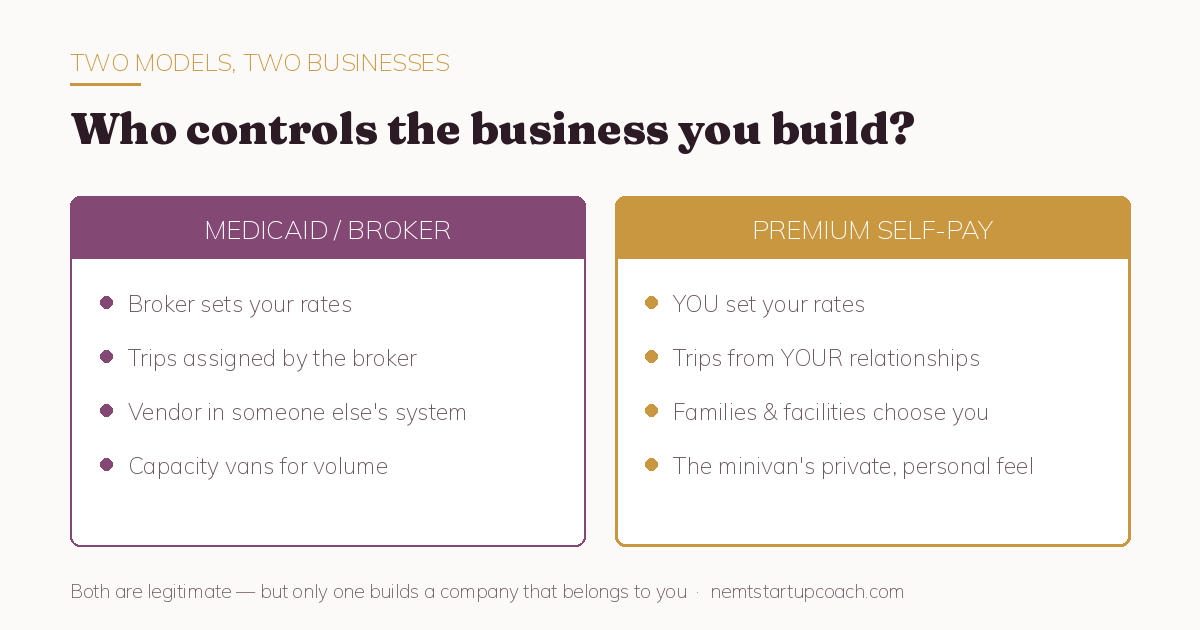
Medicaid / Broker Premium Self-Pay Who sets your rates The broker You Where trips come from Assigned by the broker Your relationships & reputation Who the client is The broker's system Families & facilities who chose you Service standard Broker's requirements Your premium standard Vehicle fit Capacity vehicles for volume The private, personal feel of a minivan Growth belongs to The broker's network Your company
That vehicle row is worth noticing — it's the same lesson from What Vehicle Do You Need for a NEMT Business?: full-size capacity vans shine in facility and broker work, while self-pay clients prefer the private feel of the minivan. The model you choose even shapes the van you buy.
Can you do both?
Some operators run broker trips for volume while building self-pay relationships on the side. It can work — but be honest about the trap: broker volume fills your calendar at broker rates, and the premium business never gets built because the van is always busy earning the lower rate. If your goal is the premium company, the premium company has to be the plan — not the someday.
Which model should YOU build?
If you want a route-style driving job with assigned trips, the broker model delivers that. But if you're a healthcare professional building a company — one with pricing power, direct relationships, and a brand that earns premium rates — then build self-pay, and build it in the right order: model, positioning, funding, then the vehicle. That's the sequence in How to Start a NEMT Business Step by Step, with the money side in How Much Does It Really Cost? and How to Get Funding.
FAQ
What is the difference between self-pay and Medicaid NEMT? In Medicaid/broker NEMT, a broker assigns your trips and sets your rates. In self-pay NEMT, private clients and facilities pay you directly at rates you set, based on relationships you build.
Is self-pay NEMT more profitable than Medicaid NEMT? Self-pay gives you pricing power — you set rates that reflect a premium service — while broker rates are set for you. Profitability in either model still depends on pricing, utilization, and cost control.
Do you need a broker contract to start a NEMT business? No. The self-pay model runs on direct relationships with families and facilities — no broker required.
Who pays for self-pay NEMT rides? Private individuals, families arranging transportation for loved ones, and facilities that book dependable transportation for residents and patients.
Can a NEMT business do both broker and self-pay work? Some do — but broker volume at broker rates can crowd out the premium business. If the premium company is the goal, build it as the plan, not the side project.
Ready to build the premium model? My free Healthcare Transportation Startup Brief walks you through the self-pay path and the right build order — before you buy the vehicle. Get the free brief here.
Coach Willena McGee, RN-BSN, is an AAA-accredited NEMT training provider (TP24831) who lost her first medical transportation company to bankruptcy and now coaches healthcare professionals to launch premium, self-pay NEMT companies the right way.
About the author Coach Willena McGee, RN BSN, is the founder of WM NEMT Startup Coach® and an AAA-accredited NEMT training provider. She coaches nurses, caregivers and career changers through building a non-emergency medical transportation company the right way, drawing on her nursing background and her lived operator experience. Work with me


