NEMT Licenses & Permits: What You Actually Need to Launch (2026)
By Coach Willena McGee, RN-BSN · AAA-Accredited NEMT Training Provider
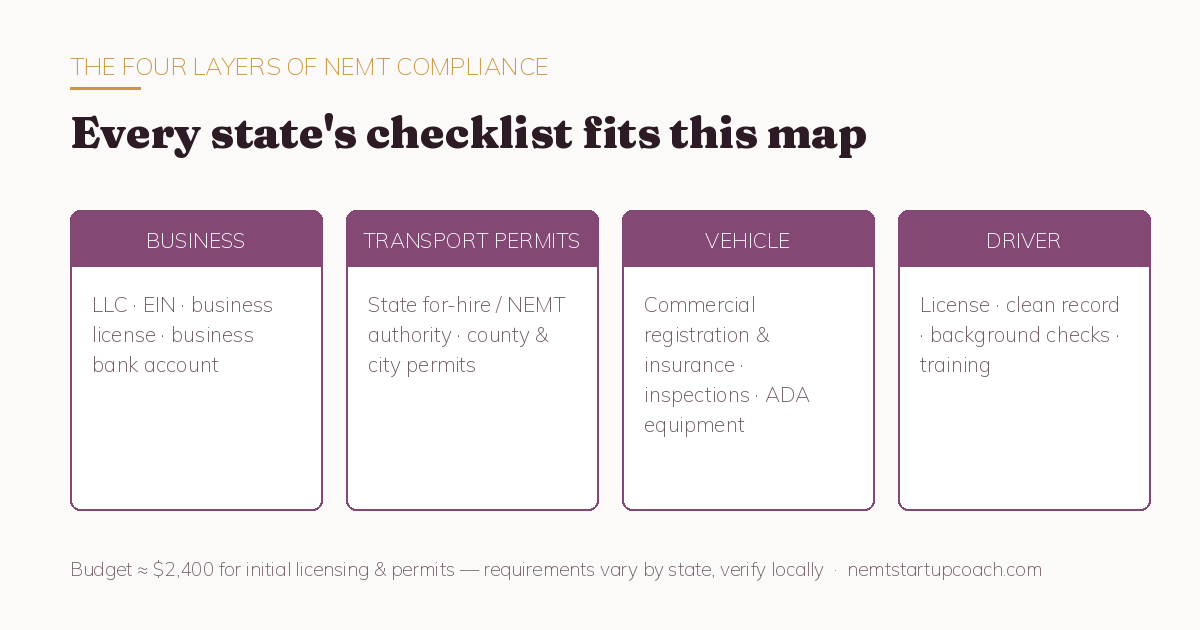
To launch a non-emergency medical transportation (NEMT) business, you'll typically need four layers of licensing and compliance: your business registrations (LLC, EIN, business license), your transportation permits (state and local for-hire or NEMT-specific authority), your vehicle compliance (registration, inspection, ADA equipment, commercial insurance), and your driver requirements (clean record, background checks, training). In my launch budget, initial licensing and permits run about $2,400. The exact requirements vary significantly by state — always verify with your state and local licensing offices before you launch.
Licensing is where a lot of aspiring NEMT owners freeze — the requirements feel like a maze, and no two states run it the same way. So let me give you the map. Not your state's specific checklist (that has to come from your state), but the four layers every checklist fits into, so you know exactly what to go verify.
Layer 1: Business registrations
This is the foundation every legitimate company needs, NEMT or not:
Business entity — form your LLC (or the structure your advisors recommend) with your state.
EIN — your federal tax ID, free from the IRS.
Business license — your state and/or city/county general business license.
Business bank account — not a license, but the clean separation of business and personal finances that lenders, insurers, and the IRS all expect.
Get these done properly and in order — this is part of the BUILD stage of the build order, and it's also the paperwork foundation for the business credit work that comes later.
Layer 2: Transportation permits
This is the layer that actually varies the most by state. Depending on where you operate, you may need:
A for-hire or passenger carrier permit — many states require vehicles that transport passengers for compensation to register with a state agency (often the DMV, DOT, or public utilities/service commission).
NEMT-specific licensure — some states have a dedicated NEMT provider license or certification; others regulate NEMT under general passenger transport rules.
County or city permits — some local governments add their own vehicle-for-hire permits on top of state requirements.
Two calls answer most of this: your state DMV/DOT and your city or county business licensing office. Ask specifically: "What permits are required to operate a non-emergency medical transportation service in this jurisdiction?" Get the answer in writing where you can.
Layer 3: Vehicle compliance
Your vehicle has its own paperwork:
Commercial vehicle registration — registered for commercial use, not personal.
Commercial auto insurance — required, and your personal policy will not cover passenger transport for compensation. Facilities and lenders will both ask for proof.
Inspections — state vehicle inspections, plus any inspection your state requires for wheelchair-accessible or for-hire vehicles.
ADA-compliant equipment — as I covered in What Vehicle Do You Need?, compliance lives in the specifics: ramp, securement systems, door dimensions, lowered floor. Keep the equipment maintained and documented.
Layer 4: Driver requirements
Whether the driver is you or someone you hire:
Valid driver's license — and for standard NEMT vehicles, usually not a CDL.
Clean driving record — insurers price on it, and facilities ask about it.
Background checks and drug screening — expected in anything healthcare-adjacent.
Training — defensive driving, wheelchair securement, passenger assistance, CPR/first aid. Some states require specific training; even where they don't, facilities notice it.
What it costs — and where it fits
In my launch model, initial licensing and permits budget at about $2,400 — a real line item, but a small one next to the vehicle and working capital. (The full budget is in How Much Does It Really Cost to Start a NEMT Business?) The bigger cost of licensing isn't money — it's the time founders lose doing it out of order, or the trouble they buy doing it incompletely. Handle it in the PREPARE stage, before the vehicle, and it's a checklist. Handle it after launch, and it's a crisis.
The mistake to avoid
Don't guess, and don't copy another state's checklist from a Facebook group. Licensing is jurisdiction-specific, and operating without a required permit can mean fines, voided insurance, or being barred from the facility relationships you worked to build. The winning move is boring: call your state and local offices, get your jurisdiction's actual list, and complete it before your first paid trip.
FAQ
What licenses do you need to start a NEMT business? Typically: business registrations (LLC, EIN, business license), state/local for-hire or NEMT-specific transportation permits, commercial vehicle registration and insurance, and driver requirements (license, clean record, background checks, training). Exact requirements vary by state.
How much do NEMT licenses and permits cost? In my launch model, initial licensing and permits budget at about $2,400 — though fees vary by state and locality.
Do you need a special license to transport wheelchair passengers? Usually not a special driver's license for standard vehicles — but your vehicle must meet ADA equipment standards, and some states require for-hire or NEMT-specific permits. Verify locally.
Who regulates NEMT businesses? It varies: state DMV/DOT, public utilities or service commissions, health agencies, and local governments can all play a role depending on your state.
Do I need Medicaid certification to run a NEMT business? Only if you pursue Medicaid/broker work. The self-pay model — private clients and facilities paying you directly — doesn't require Medicaid enrollment. See Self-Pay vs. Medicaid NEMT.
Want the whole launch path in the right order — licensing included? My free Healthcare Transportation Startup Brief walks you through the premium self-pay model step by step. Get the free brief here.
Coach Willena McGee, RN-BSN, is an AAA-accredited NEMT training provider (TP24831) who lost her first medical transportation company to bankruptcy and now coaches healthcare professionals to launch premium, self-pay NEMT companies the right way.
This article is general education, not legal advice. Licensing requirements vary by state and locality — verify with your state and local licensing offices.
About the author Coach Willena McGee, RN BSN, is the founder of WM NEMT Startup Coach® and an AAA-accredited NEMT training provider. She coaches nurses, caregivers and career changers through building a non-emergency medical transportation company the right way, drawing on her nursing background and her lived operator experience. Work with me


