Is an NEMT Business Profitable? Real Margins & Earnings (2026)
By Coach Willena McGee, RN-BSN · AAA-Accredited NEMT Training Provider
Yes — a non-emergency medical transportation (NEMT) business can be genuinely profitable, but profitability is decided by the model, not the industry. The demand is real and growing; what separates profitable companies from struggling ones is the spread between the true cost of a trip and the price charged for it, multiplied by how full the schedule runs. Broker-dependent companies operate on rates someone else sets — usually thin. Premium self-pay companies set their own prices from their real costs up — and that pricing power is where NEMT profit actually lives.
I'm going to give you the honest version of this answer — the one I wish someone had given me before my first non-emergency medical transportation company. Because "is NEMT profitable?" is the wrong first question. The right one is: profitable under which model?
The profit equation nobody shows you
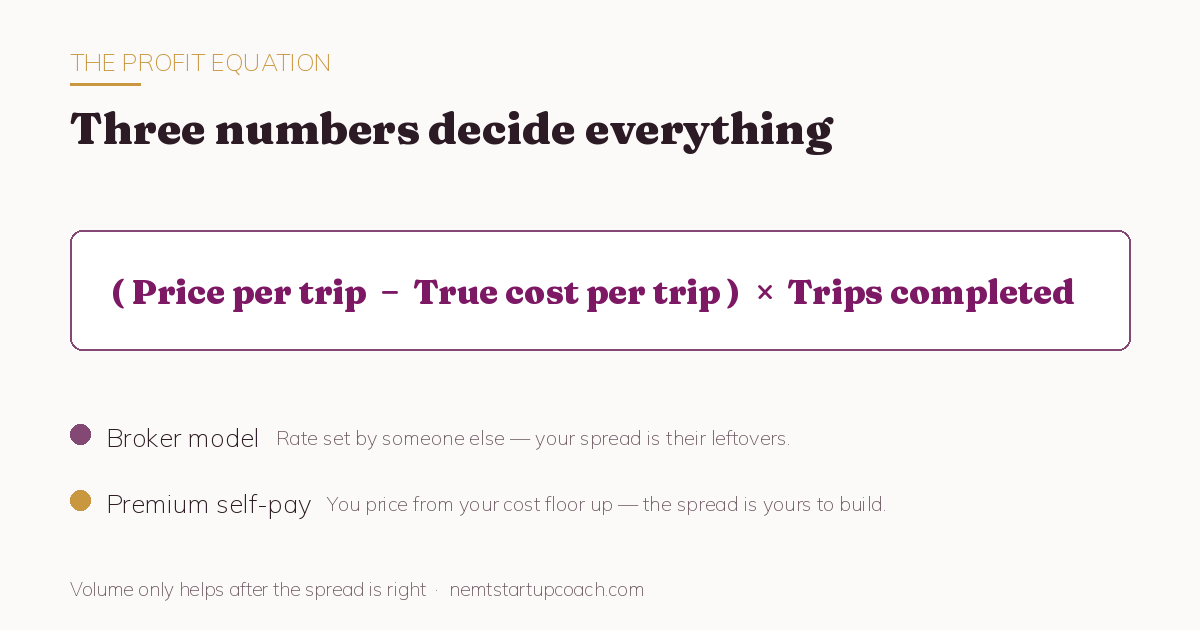
Every NEMT company's profit comes down to one simple structure:
(Price per trip − True cost per trip) × Trips completed
Three numbers. And most owners only ever look at the third one — they chase trip volume while the first two quietly decide whether volume helps or hurts. If the spread between price and true cost is negative, more trips just means losing money faster. That's how companies stay "busy" all the way to closing — the exact trap I unpacked in Why NEMT Businesses Fail.
What a trip really costs
The "true cost" side is where new owners fool themselves. A trip doesn't just cost fuel. It carries its share of the vehicle payment, commercial insurance, maintenance, the driver's time (including deadhead miles with nobody in the vehicle), dispatch and admin time, and the downtime between trips. When owners count all of it, many discover that trips they thought were earning money were costing it.
This is why I teach the full launch math up front — the real startup number is around $120,000, including roughly $44,600 in working capital — because a company that launches underfunded is forced to accept any trip at any rate, and that desperation pricing is where profitability dies.
The two models, and where the profit lives
The broker model: volume can be steady, but the rate is set by someone else, and it's set for their margin, not yours. Your only levers are volume and cost-cutting — and you can't cost-cut your way past a rate ceiling. I compared the models fully in Self-Pay vs. Medicaid NEMT.
The premium self-pay model: you serve families, private clients, and facilities directly, and you price the service as what it is — healthcare transportation with trained drivers, door-through-door assistance, and dignity. You set the price from your cost floor up. That's pricing power, and pricing power is the difference between a job with a van payment and a company with margins.
Most profitable NEMT companies I work with aren't the busiest ones. They're the ones with the healthiest spread.
So… is it profitable?
Honestly: it can be, and for well-built companies it is — but nothing about NEMT makes profit automatic. I'll never promise you income; anyone who does is selling you something dishonest. What I can tell you is what the profitable companies have in common: they knew their true cost per trip before they launched, they priced from that floor up instead of copying broker rates, they protected capacity for premium work, and they launched with enough working capital that they never had to price from desperation.
Profitability isn't found in NEMT. It's built into the company — in the model, the pricing, and the order you build in. That's the whole reason my method runs BUILD → POSITION → PREPARE → PROFIT: profit is the last stage because the first three create it.
FAQ
How profitable is a NEMT business? It depends entirely on the model: the spread between price per trip and true cost per trip, times completed trips. Broker-dependent companies typically run thin spreads; premium self-pay companies control their pricing and can build healthier margins. No specific income can be promised — profitability is built, not guaranteed.
How much does a medical transportation business make per month? There's no honest single number. Monthly profit is your trips times your rate, minus your real cost per trip and your fixed overhead, which is why two companies with the same van land in completely different places. The equation above shows you how to run it for your market.
Is NEMT a good business to start in 2026? Demand keeps growing with the aging population, and the opportunity is real. Whether it's good for you depends on building in the right order — model and pricing before the vehicle — and launching with adequate working capital.
Why do so many NEMT businesses struggle financially? Most commonly: broker-rate ceilings, underpricing that ignores true per-trip cost, and launching without working capital — which forces desperate pricing.
Do you make more money with self-pay or Medicaid NEMT? Self-pay offers pricing power — you set rates from your costs and your positioning. Broker/Medicaid work offers assigned volume at rates set by others. Many strong companies are built self-pay-first for exactly that reason.
What determines NEMT profit the most? Pricing built from your true cost floor, and the discipline to protect it. Volume matters only after the spread is right.
Want to build the numbers side like a CEO? My Build Before You Borrow business planning masterclass walks you through the model, the projections, and the plan — the actual math behind a fundable, profitable company. Join Build Before You Borrow here.
Not ready yet? Start with my free Healthcare Transportation Startup Brief: Get the free brief here.
Coach Willena McGee, RN-BSN, is an AAA-accredited NEMT training provider (TP24831) who lost her first non-emergency medical transportation company to bankruptcy and now coaches healthcare professionals to launch premium, self-pay NEMT companies the right way. Learn about her NEMT business consulting.
About the author Coach Willena McGee, RN BSN, is the founder of WM NEMT Startup Coach® and an AAA-accredited NEMT training provider. She coaches nurses, caregivers and career changers through building a non-emergency medical transportation company the right way, drawing on her nursing background and her lived operator experience. Work with me


