Why NEMT Businesses Fail — and How to Avoid It (2026)
By Coach Willena McGee, RN-BSN · AAA-Accredited NEMT Training Provider
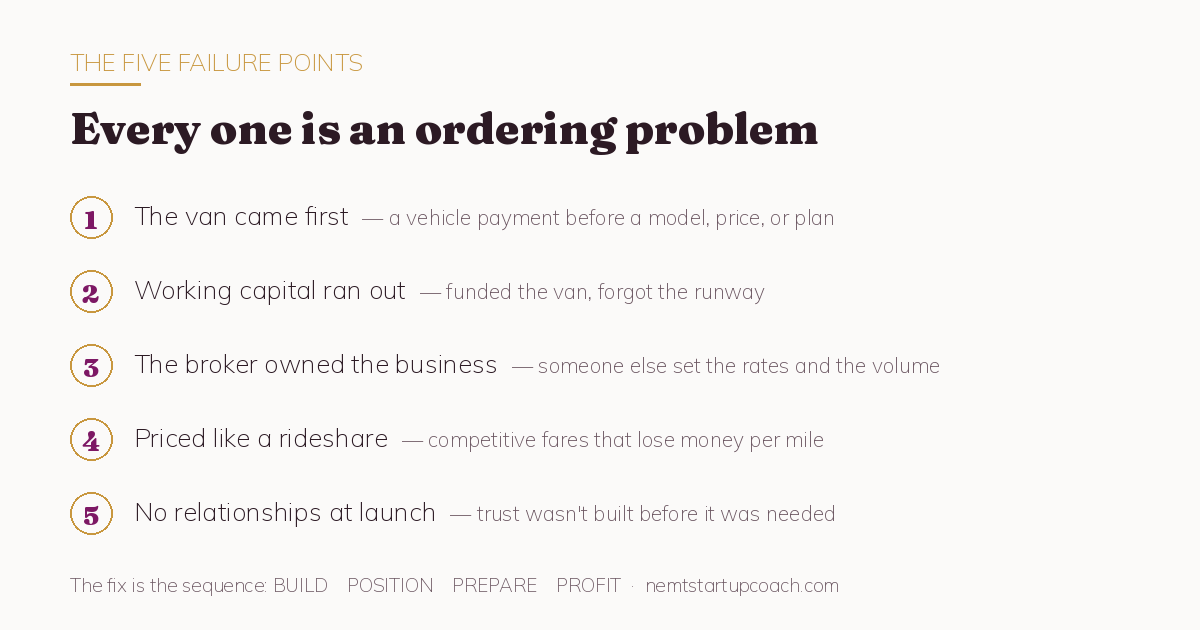
Most non-emergency medical transportation (NEMT) businesses that fail don't fail because the demand isn't there — the demand is enormous. They fail for five preventable reasons: buying the vehicle before building the business, running out of working capital, depending on a broker for rates and volume, pricing like a rideshare instead of a healthcare service, and launching with no referral relationships. I know these five personally — my first medical transportation company ended in bankruptcy. Every one of them is avoidable when you build in the right order.
I don't write about failure from a textbook. I write about it from the other side of losing a company I loved. That season cost me everything — and it taught me exactly where this business breaks. If you're building a NEMT company, or thinking about it, these are the five failure points to build against from day one.
Reason 1: The van came first
The most common failure starts at the dealership. A new owner buys the vehicle — the exciting part — before there's a model, a price, a client, or a funding plan behind it. Now there's a payment due every month and a business being improvised around it.
The vehicle is not the business. The vehicle is a tool the business uses. When the van comes first, every decision after it is made under pressure — and pressured decisions are how owners end up accepting any trip at any rate just to cover the note. The fix is the build order I teach: model, positioning, funding — then the vehicle.
Reason 2: Working capital ran out
This is the silent killer, and it's the one that took my first company. Owners budget for the vehicle and forget the runway — the working capital that pays for insurance, fuel, marketing, and life while trip volume ramps up.
Here's the trap: lenders will finance the vehicle, because a vehicle is a recoverable asset. They resist funding working capital. So new owners get approved for the van, feel funded, and launch with no runway — then discover that trips build over months, not weeks. A company with a paid-for van and an empty operating account is still a failed company. Getting funded for both the asset and the runway is the heart of what I teach in How to Get Funding for a NEMT Business.
Reason 3: The broker owned the business
Broker and Medicaid work looks like the easy on-ramp: sign up, get assigned trips, start driving. But read what you actually signed up for — the broker sets your rates, controls your volume, and can thin your trip flow without explanation. Your revenue lives in someone else's hands.
I compared the two models honestly in Self-Pay vs. Medicaid NEMT. The short version: broker work can fill a calendar, but at broker rates it often can't fund a company — and the owners grinding hardest are usually the ones most dependent on it. If that's where you are right now, hear me clearly: you are not stuck. The transition to self-pay is a build, and it can be done.
Reason 4: Priced like a rideshare, not a healthcare service
Underpricing kills quietly. New owners benchmark against rideshare fares or broker rates, win trips easily at numbers that feel competitive — and lose money on every mile once the vehicle, insurance, driver, and downtime are truly counted.
Premium self-pay NEMT is a healthcare service: door-through-door assistance, trained drivers, ADA equipment, dignity. It must be priced like one. Pricing is a math problem — your cost floor plus your margin — anchored by positioning that justifies the number. If the price only works when nothing goes wrong, it doesn't work.
Reason 5: Launch day arrived with no relationships
A van, a logo, and a website are not a demand engine. The owners who struggle longest are the ones who launched and then started introducing themselves. Facilities refer operators they already trust — and trust is built before it's needed. That's why relationship-building lives in the POSITION stage of my framework, before the vehicle ever arrives, and it's the entire subject of How to Get Facility Contracts.
How to avoid all five: build it in the right order
Look back at those five failures and notice something: every single one is an ordering problem. The van before the model. The launch before the runway. The broker before the brand. The price before the math. The open sign before the relationships.
That's why my whole method is a sequence — BUILD → POSITION → PREPARE → PROFIT — where every stage funds and de-risks the next. It's the order I wish someone had handed me before my first company, and it's the order I now walk healthcare professionals through as an AAA-accredited training provider. Failure in this industry is common. It is not required.
FAQ
What is the main reason NEMT businesses fail? Building in the wrong order — most commonly buying the vehicle before the model, pricing, funding, and relationships exist, and then running out of working capital while trips ramp up.
How much working capital does a NEMT business need? In my launch model, the working capital reserve is roughly $44,600 of the ~$120,000 launch budget — the runway that carries operations while trip volume builds.
Is the NEMT industry oversaturated? No — demand for dignified, dependable medical transportation keeps growing with the aging population. Failures are almost always execution and ordering problems, not demand problems.
Can a struggling broker-dependent NEMT business turn around? Yes. Broker dependence is a model problem, and models can be rebuilt — the transition to self-pay is a deliberate build of positioning, pricing, and direct relationships.
How do I avoid failing in my first year of NEMT? Follow the sequence: design the model and pricing first, build referral relationships before launch, secure funding for both the vehicle and working capital, and buy the vehicle last.
Build against all five from day one. My free Healthcare Transportation Startup Brief walks you through the premium self-pay model in the right order — before you buy the vehicle. Get the free brief here.
Coach Willena McGee, RN-BSN, is an AAA-accredited NEMT training provider (TP24831) who lost her first medical transportation company to bankruptcy and now coaches healthcare professionals to launch premium, self-pay NEMT companies the right way.
About the author Coach Willena McGee, RN BSN, is the founder of WM NEMT Startup Coach® and an AAA-accredited NEMT training provider. She coaches nurses, caregivers and career changers through building a non-emergency medical transportation company the right way, drawing on her nursing background and her lived operator experience. Work with me


