From Broker to Self-Pay: How to Transition Your NEMT Business (2026)
By Coach Willena McGee, RN-BSN · AAA-Accredited NEMT Training Provider
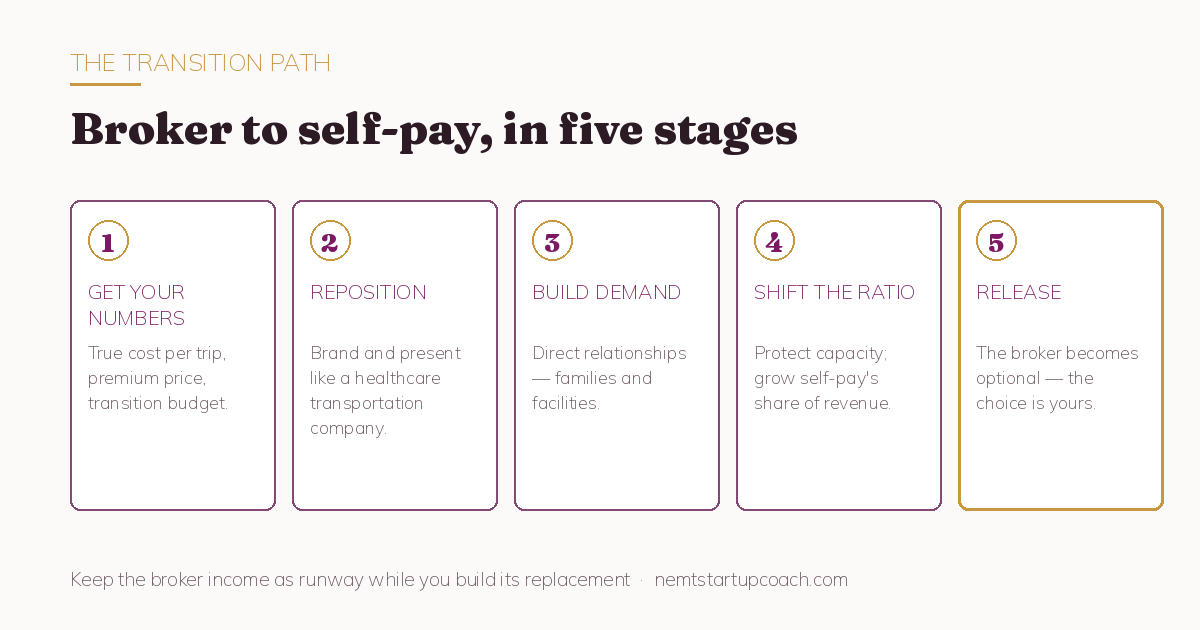
Transitioning a NEMT business from broker work to self-pay is a deliberate build, not a leap. You don't quit the broker on Monday — you build the premium business alongside the broker trips, in order: get your real numbers, reposition your brand as a healthcare transportation company, build direct demand with families and facilities, shift your capacity toward self-pay trips as they grow, and let the broker become optional instead of essential. Operators do make this transition — but only the ones who treat it as a build.
If you're running broker trips right now, you already know the math I don't have to explain to you: the rates you didn't set, the volume you can't control, the weeks the trip flow thins out with no explanation. You're working — hard — inside someone else's business. This post is the path out. Not a motivational leap; a sequence.
First, the honest diagnosis
Go back to Self-Pay vs. Medicaid NEMT if you haven't read it: the broker model isn't evil, it's just a business where someone else holds the controls. The transition question isn't "how do I escape the broker" — it's "how do I build a business that doesn't need one?" Those are different projects. The first is an exit; the second is a build. We're doing the build.
Stage 1: Get your real numbers
Before anything changes on the outside, do the math on the inside:
Your true cost per trip — vehicle, insurance, fuel, driver time, downtime. Most broker operators have never fully counted it, because the broker rate was the ceiling anyway.
Your premium price — what your service is worth when it's priced as healthcare transportation: door-through-door assistance, trained driver, dignified experience. Priced from your cost floor up, not from the broker rate sideways.
Your transition budget — repositioning takes some fuel: branding, a real website, time for relationship-building. Know what you're investing before you start.
If the numbers conversation feels like the hard part, that's normal — it's also exactly where most NEMT businesses quietly fail, so it's where the rebuild starts.
Stage 2: Reposition as a healthcare transportation company
A discharge planner or a family comparing options will judge you in seconds. If your company looks like a broker vendor — generic name, no website, no visible standards — you'll be treated (and paid) like one.
Repositioning means: professional brand and website, visible driver training and standards, a clean ADA-compliant vehicle presented like the healthcare asset it is, and messaging that speaks to families and facilities — not to brokers. You're not becoming a different company; you're finally looking like the company you already are.
Stage 3: Build the self-pay demand engine
Self-pay demand comes from two directions, and you build both:
Facilities — assisted living, dialysis, rehab, discharge teams. The relationship path is the whole subject of How to Get Facility Contracts: identify, connect, prove, formalize.
Families and private individuals — adult children arranging dependable transport for a parent, private clients who will gladly pay for dignity and punctuality.
Here's your unfair advantage as a broker operator: you already know how to run trips. The operational muscle most startups lack, you have. What you're adding is demand that belongs to you.
Stage 4: Shift the ratio deliberately
This is the stage where most transitions die, so mark it: broker volume will happily eat every hour your vehicle has. If you accept every assigned trip, the premium business stays a someday.
The discipline is capacity protection: block real windows for self-pay trips and relationship-building, and grow those blocks as self-pay revenue grows. Watch one number — the percentage of revenue coming from self-pay — and move it month over month. You're not quitting the broker; you're demoting it, one scheduling block at a time.
Stage 5: Release the floor
There's a point — you'll see it in your numbers — where broker trips are no longer the floor holding you up, but the ceiling holding you down: hours at low rates that could be premium trips. That's when the broker becomes optional. Some operators keep a little broker work as filler; many let it go entirely. Either way, the decision is finally yours — which was the whole point.
The mistakes to avoid
Quitting cold. Income you haven't replaced yet is runway — don't burn it for pride.
Self-pay trips at broker-ish prices. If you carry the old rate mindset into the new model, you've changed clients, not businesses.
Skipping the repositioning. Premium clients won't pay premium rates to a company that presents like a vendor.
Doing it without a sequence. A transition is a build — and builds fail in the wrong order, the same five ways they always fail.
FAQ
Can you switch a NEMT business from Medicaid broker work to private clients? Yes — by building the self-pay side alongside broker trips: reposition the brand, set premium pricing, build direct demand with families and facilities, then shift capacity as self-pay revenue grows.
How long does the broker-to-self-pay transition take? It's a build measured in months, not days — the pace depends on your relationship-building, your repositioning, and how deliberately you protect capacity for self-pay trips.
Should I quit my broker contract before going self-pay? No. Keep the broker income as runway while you build the replacement, then reduce it deliberately as self-pay revenue takes over.
Why do self-pay clients pay more than broker rates? Because they're buying a different product: a premium healthcare transportation experience — dignified, punctual, door-through-door — priced from its real cost and value, not from a broker's rate sheet.
What's the first step to transition from broker to self-pay NEMT? Your numbers: true cost per trip, your premium price, and your transition budget. Every other stage builds on that math.
Ready to make the transition a build, not a wish? This is exactly what my NEMT Setup Certainty — walks you through step by step what you have built for.
Not ready for the bootcamp? Start with my free Healthcare Transportation Startup Brief: Get the free brief here.
Coach Willena McGee, RN-BSN, is an AAA-accredited NEMT training provider (TP24831) who lost her first medical transportation company to bankruptcy and now coaches healthcare professionals to launch premium, self-pay NEMT companies the right way.
About the author Coach Willena McGee, RN BSN, is the founder of WM NEMT Startup Coach® and an AAA-accredited NEMT training provider. She coaches nurses, caregivers and career changers through building a non-emergency medical transportation company the right way, drawing on her nursing background and her lived operator experience. Work with me


