How to Get Self-Pay NEMT Clients: Families & Private Individuals (2026)
By Coach Willena McGee, RN-BSN · AAA-Accredited NEMT Training Provider
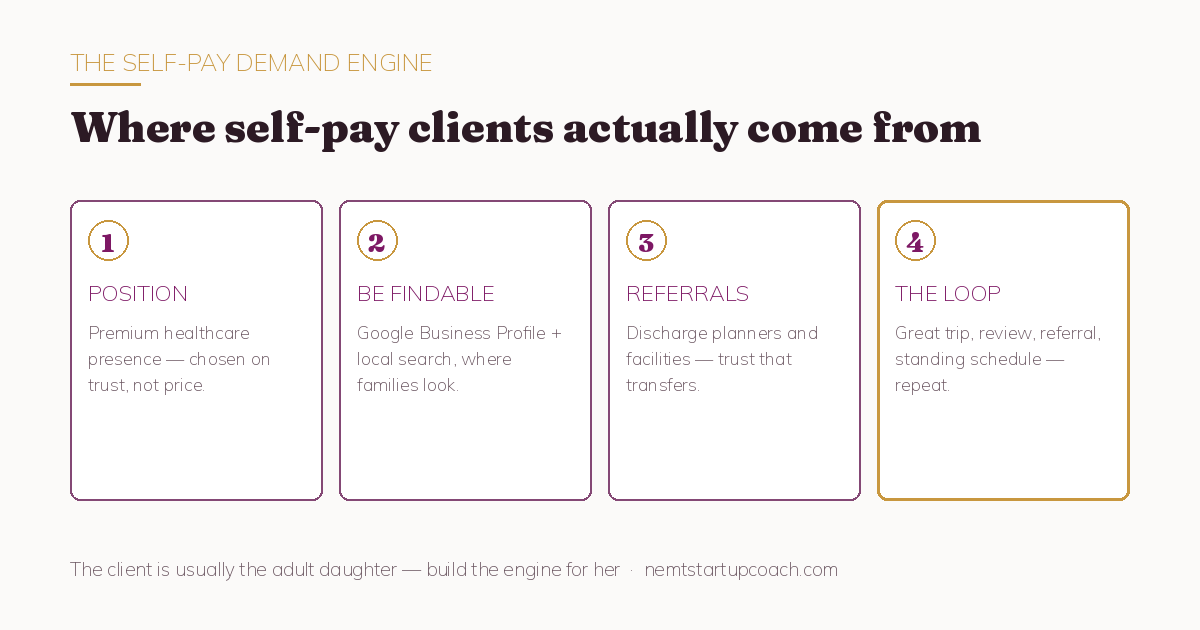
Getting self-pay (private pay) clients for a non-emergency medical transportation (NEMT) company comes from building a demand engine with four parts: positioning your company as premium healthcare transportation, being findable where families actually search (Google Business Profile and local search), earning facility and discharge-planner referrals, and turning every completed trip into the next one through reviews and referral loops. Self-pay clients don’t come from a broker portal — they come from trust, built before it’s needed.
Here’s the truth about the self-pay side that nobody tells new owners: the client is usually not the passenger. The person finding you, vetting you, and paying you is most often an adult daughter or son arranging dependable transportation for a parent — dialysis three times a week, a specialist across town, a discharge home from rehab. Build your entire demand engine for that person, and the trips follow.
Part 1: Position like healthcare, not like a ride
Before any marketing works, the company has to read right. When that adult daughter lands on your website at 10 p.m., worried about her mother, she’s making a trust decision in about eight seconds: professional brand, trained drivers, door-through-door assistance, ADA equipment presented like the healthcare asset it is, and real reviews. If your company presents like a rideshare with a lift, you’ll be compared on price. If it presents like healthcare, you’ll be chosen on trust — which is the entire premium model, and the reason pricing power exists at all.
Part 2: Be findable where families search
Families don’t search broker portals — they search Google: “wheelchair transportation near me,” “senior transportation [your city],” “dialysis transportation.” Which makes two assets non-negotiable:
Your Google Business Profile. Complete it fully — services, photos of your actual vehicle and team, hours, service area — and post to it weekly. Reviews here are your storefront: after every great trip, ask for one. Ten genuine reviews from relieved families outsell any ad.
Your website’s local presence. Service pages that name your city and services in plain language, answers to the questions families actually type, and one clear next step (call or request a quote).
This is slow-burn marketing that compounds — the same way this blog you’re reading grew from nothing.
Part 3: Facility and discharge-planner referrals
Families trust the professionals in front of them. When a discharge planner, dialysis social worker, or assisted-living director hands someone your card, the trust transfers with it. That relationship path — identify, connect, prove, formalize — is its own discipline, and I wrote the full playbook in How to Get Facility Contracts. The short version: these referrals are built before launch, person by person, by being the operator who shows up, communicates, and never makes them look bad for recommending you.
Part 4: Turn every trip into the next one
Self-pay demand snowballs when you work the loop: exceptional trip → review request → referral ask → repeat schedule. Standing appointments (dialysis, therapy, adult day programs) are the backbone — one family’s recurring schedule is worth more than twenty one-off trips. Treat the family as the client: confirm pickups, communicate delays, close the loop after the trip. The daughter who trusts you tells her church, her coworkers, and her mother’s whole care team.
The mistakes that stall the self-pay side
Marketing to the passenger instead of the decision-maker. Speak to the adult child arranging care.
Launching, then introducing yourself. Relationships are built in the POSITION stage — before the vehicle arrives, in the right order.
Competing on price. Underpricing attracts price-shoppers and repels the trust-buyers you actually want.
Ignoring the profile. An empty Google Business Profile tells a worried family you might not really be in business.
FAQ
How do NEMT companies find private pay clients? Through local search visibility (Google Business Profile + a real website), facility and discharge-planner referrals, community presence, and referral loops from completed trips — built around the adult children who typically arrange and pay for a parent’s transportation.
Who pays for self-pay NEMT rides? Most often family members — adult children arranging transportation for aging parents — along with private individuals, and sometimes facilities or programs paying directly for their residents.
Do I need a broker to get NEMT clients? No. Brokers assign trips at rates they set. Self-pay demand is built directly — search presence, referrals, and reputation — and it belongs to your company, not a portal.
How long does it take to get self-pay NEMT clients? It builds over months, not days — which is why relationship-building starts before launch and why standing appointments matter: each recurring client compounds your base.
What’s the fastest first step to get self-pay clients? Complete your Google Business Profile and start the facility relationship path — those two assets do the most work for a new premium company.
Want the full model behind the premium self-pay company? Start with my free Healthcare Transportation Startup Brief — the right build order, before you buy the vehicle. Get the free brief here.
Coach Willena McGee, RN-BSN, is an AAA-accredited NEMT training provider (TP24831) who lost her first non-emergency medical transportation company to bankruptcy and now coaches healthcare professionals to launch premium, self-pay NEMT companies the right way.
About the author Coach Willena McGee, RN BSN, is the founder of WM NEMT Startup Coach® and an AAA-accredited NEMT training provider. She coaches nurses, caregivers and career changers through building a non-emergency medical transportation company the right way, drawing on her nursing background and her lived operator experience. Work with me


